Building on Naomi Klein's suggestion for climate change to become the grand push to bring together all living movements (Klein, 2015), this research project asks and answers, ‘How can climate change be the grand push to nurture the Right to the City?’ As around 150 cities are already recognised to have Paris Agreement-verified climate action plans (C40, 2022; CDP-ICELI Track, 2023), urban scholars warn that carbon-led climate urbanism continues capitalistic accumulation and compounds inequalities (Long and Rice, 2020; Shi, 2020). Hence, grounded in a constructivist epistemology, this research explores a qualitative mixed-methodology for creating a Right to the City Actions List, analysing the alignment of the local climate action measures with that list, and drawing recommendations to reshape the local climate action planning processes. This is an attempt to establish a theoretical and policy-level synergy between the Right to the City and local climate action movements and contribute a new knowledge pathway to the emerging climate urbanism literature.
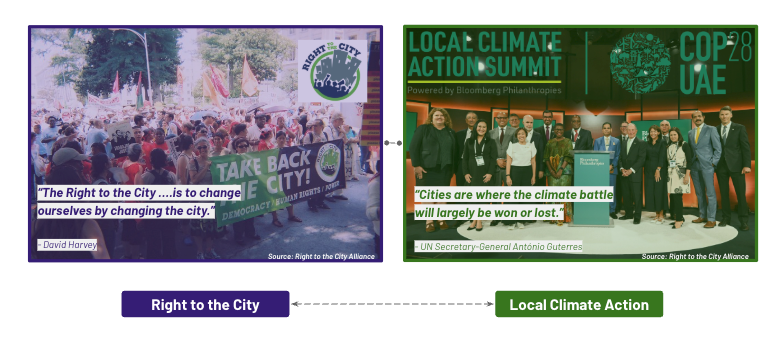
An illustrated graphic juxtaposing two images; one of a citizens' march with a banner 'Take Back The City' highlighting the rights based movement, and the other from the COP-29 Local Climate Action Summit with leaders from various regions.
Methodology
The primary research question—How can climate change be the grand push to nurture the Right to the City?—was supported by three secondary research questions. They are: 1) What actions would nurture the Right to the City? 2) How do the present local climate action responses from cities align with the actions for the Right to the City? and 3) How can climate action planning become a tool to nurture the Right to the City? This strategically foregrounds two forms of data: 1) the academic and grey literature available on the Right to the City, and 2) City Climate Action Plans (CCAPs), a strategic policy document(s) that illustrates a roadmap for local climate action.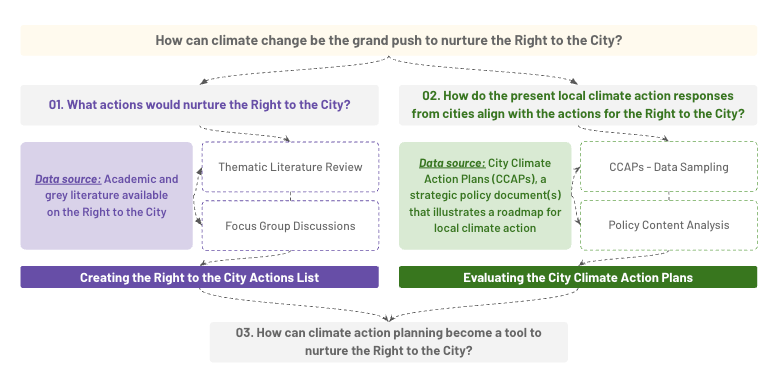
Illustration summarising the research methodology
The Right to the City Actions List
“To challenge rights is to challenge the social process, and vice versa, …that social process depends upon a juridical construction of individual rights” (Harvey, 2003). Only actions that challenge social processes and change them over time are capable of challenging the form and function of existing rights and instituting new ones. In other words, finding the actions that nurture the Right to the City begins with finding the actions that challenge the current social processes. They are the same, or one leads to the other. David Harvey (2008) also argues, “The question of what kind of city we want cannot be divorced from that of what kind of social ties, relationship to nature, lifestyles, technologies, and aesthetic values we desire,” strongly establishing the link between urban life and the socio-economic imagination.
Also, from the perspective of the climate crisis, the Intergovernmental Panel on Climate Change (IPCC) warns that “...without societal transformation and rapid implementation of ambitious greenhouse gas reduction measures, pathways to limiting warming to 1.5°C and achieving sustainable development will be exceedingly difficult, if not impossible,” and places 'societal transformation’ on par with ‘reducing GHGs’ for achieving the global temperature goal (Roy, Tschakert and Waisman, 2018). This lays out the characteristics of the ‘actions to nurture the Right to the City,’ especially in the context of climate change—have a socio-economic imagination, challenge the social process, and change them.
Read Blog 22: Constructs of the Right to the City for more details.
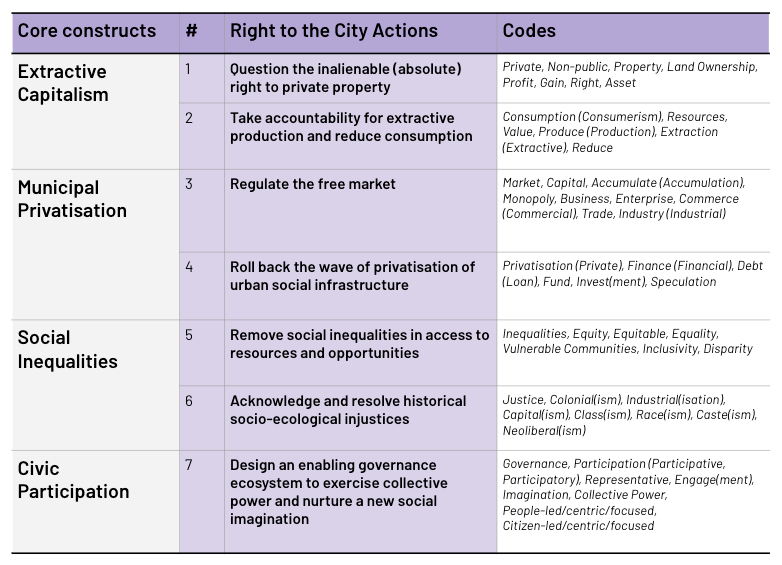
Table 1: The seven-point Right to the City Actions List and priori-codes were prepared in alignment with the core constructs of the Right to the City and adopted for reviewing the CCAPs.
Evaluating the City Climate Action Plans
The CCAPs and annex documents of the 150 unique cities recognised by either the C40 Cities Climate Leadership Group Inc. (C40) or the CDP-ICELI Track as cities with Paris-Agreement-verified climate commitments formed the primary data set for this part of the research. Through a rigorous inclusion and exclusion criteria, fifteen cities—Accra, Adelaide, Amman, Amsterdam, Berlin, Cape Town, Chennai, Chicago, Copenhagen, Jakarta, Nairobi, Salvador, Seoul, Toronto, and York—a ten percent sample size were handpicked to represent the diverse development regions (Global North vs. Global South), geographical and socio-political contexts (15 countries), and territorial scales (2030 projected population of urban agglomerations ranging between 1.2 and 130 million).
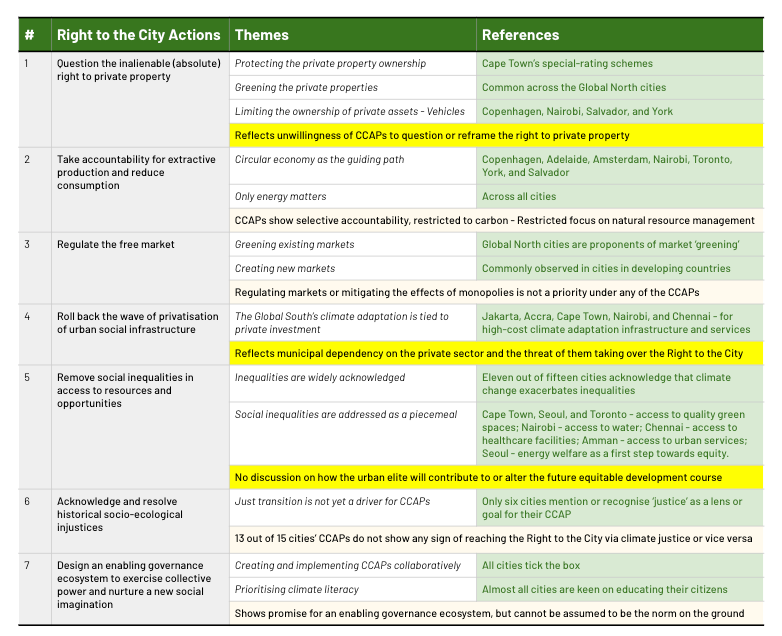
International development practices position local climate action as a science-based reform for city-making. However, the review of the CCAPs suggests that it is also substantially market-based, and the practitioners from the focus groups widely agreed that it is also a top-down and convenience-based effort. 13 of the 15 cities do not mention ‘Rights’ as an idea or an approach. The only exceptions are Seoul and Chennai, with passing remarks and no solid articulation or commitment.
Conventional urban planning practices are often criticised for being non-participative and operating as a means for deliberate social control and oppression (Yiftachel, 1998). Without adopting an altered way of planning that exercises deliberative democracy and reforms the power systems, climate action planning could also fall into the same technocratic category. From this perspective, this research argues that the answer to ‘How can climate change be the grand push to nurture the Right to the City?’ lies within ‘How can climate action planning become a tool to challenge and change social processes (to nurture the Right to the City)?’ If claiming the Right to the City is a way-station to overthrow capitalist power systems, democratising climate action planning could be a way-station to claim the Right to the City (Harvey, 2013).
Note: The complete research is yet to be published.
Bibliography
C40 (2022) Mapped: Cities with a climate action plan. Available at: https://www.c40knowledgehub.org/s/article/Mapped-Cities-with-a-climate-action-plan?language=en_US (Accessed: 14 August 2024).
CDP-ICELI Track (2023) Cities scores - CDP. Available at: https://www.cdp.net/en/cities/cities-scores (Accessed: 14 August 2024).
Harvey, D. (2003) ‘The right to the city’, International Journal of Urban and Regional Research, 27(4), pp. 939–941. Available at: https://doi.org/10.1111/j.0309-1317.2003.00492.x.
Harvey, D. (2013) Rebel cities: from the right to the city to the urban revolution. Verso. Available at: https://hdl-handle-net.gate3.library.lse.ac.uk/2027/heb32147.0001.001 (Accessed: 15 August 2024).
Klein, N. (2015) This changes everything: capitalism vs. the climate. First Simon&Schuster trade paperback edition. New York: Simon & Schuster Paperbacks.
Long, J. and Rice, J.L. (2020) ‘Climate urbanism: crisis, capitalism, and intervention’, Urban Geography, 42(6), p. 721.
Roy, J., Tschakert, P. and Waisman, H. (2018) ‘Chapter 5 — Global Warming of 1.5 oC’. Available at: https://www.ipcc.ch/sr15/chapter/chapter-5/ (Accessed: 15 August 2024).
Shi, L. (2020) ‘The New Climate Urbanism: Old Capitalism with Climate Characteristics’, in V. Castán Broto, E. Robin, and A. While (eds) Climate Urbanism: Towards a Critical Research Agenda. Cham: Springer International Publishing, pp. 51–65. Available at: https://doi.org/10.1007/978-3-030-53386-1_4.
Yiftachel, O. (1998) ‘Planning and Social Control: Exploring the Dark Side’, Journal of Planning Literature, 12(4), pp. 395–406. Available at: https://doi.org/10.1177/088541229801200401.